Tuesday, March 26, 2013

Metrobus Line 5 Unveiled Today at a Press Conference in Mexico City.


Today marked the official unveiling of the new Metrobus line which will be known as Line Number 5. At a press conference today on Mexico City’s Zocolo, the head of city government, Miguel Angel Mancera, announced the construction of the new line which will be the first in Mexico City to incorporate a “Complete Streets” design. As with most complete streets, the new line will integrate public transit, pedestrian circulation and bike routes. The new route will also accommodate a separate route for large trucks in order to improve traffic flow. In addition the city will construct hanging/vertical gardens and plant numerous trees along the new route which are meant to lessen the impacts of pollution.

The route will run from Rio de los Remedios in the north part of the city and end at the San Lazaro Metro Station in the center of the City. This is important because San Lazaro is the location of the TAPO bus station which ia one of the largest regional/national bus stations in the city, providing yet another level of connectivity for transit users. You can see the map of Route 5 in the graphic below.


Due to of the construction of this new line, many smaller, more polluting buses will be taken out of circulation. It is expected that the construction of the new Metrobus line will result in the removal of over 122,000 tons of pollution annually from the city’s notoriously polluted air, thus providing a cleaner and safer solution for Mexico City commuters and residents alike. According to city statistics, the new route is also projected to provide a 40% reduction in travel time based on today’s traffic counts.

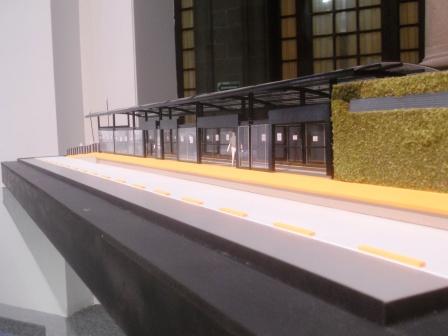
The Secretary of Construction, Luis Albert Rabago, indicated that the total investment in the new project will cost 800 million pesos (64.7 million U.S. dollars) and benefit over 50,000 users per day. The new line will run more than 10 kilometers and will consist of 18 state of the art stations, which will be constructed using prefabricated modules which will save construction time and control costs on the project’s installation. Below is a photo of the model of a new station which was presented at today’s press conference.


The announcement of this line is the first on many more which are expected to be constructed across the city in the next several years. The first phase of this new line is expected to be operational within the next six months. Expect more information to be posted here as the construction of more lines are announced.

Tuesday, March 12, 2013

Big Changes: Mexico Unveils Its New Housing Policy

Mexican president Enrique Peña Nieto recently presented his plans for National Housing Policy, all of which are directed at curbing the sprawl that has plagued Mexican cities, causing many social problems. The president´s plans are built around four main points that are meant to promote a new paradigm of urban development. These points are as follows:

1. Achieve coordination among all agencies and stakeholders

2. Promote sustainable development

3. Make it easier to acquire housing

4. To provide high quality housing for all

In order to move these changes forward, the president has promised to reorient all loans and grants from the government to support well planned and orderly urban growth, as well as high density vertical development within urban areas. The main reasons for this are to control the urban sprawl that has consumed an exorbitant amount of land around the major cities as well as lessen the high social cost and economic burdens that come with the commuting from homes so far out from the urban centers and job sources.

One of the strongest needs in Mexican development is point number one. There is a lack of continuity between regulations and communication on the local, state and national levels. This must be completed before any of the latter steps can be implemented correctly. The second point is to promote sustainable and orderly development. As touched upon before, the government plans to do this through financial means, only making loans and grants to projects that can prove they are supporting the government´s goals of intelligent and orderly urban growth. The third point will be done in conjunction with banks, streamlining processes as well as allowing more flexibility for the rehabilitation of existing properties rather than encouraging new construction and sprawl. Finally the last point is to promote higher quality construction in order to provide more dignified living conditions, particularly in the rural areas where the quality of housing is lowest. The government is giving construction companies a grace period of 24 months or 2 years in order to comply with the changes.

Mexican cities have been growing rapidly in the last few years but the quality of development has varied. There have been many problems with the construction of new housing including poorly planned neighborhoods, low quality construction and a lack of oversight by local governments to ensure that the homes are being built to code. Taking steps to change the way development takes place in Mexico is a positive first step even though we have a long way to go in order to raise the quality of living to that of many other developed countries. No place is this more true than in the rural areas, where quality development according to international standards is more than lacking. I am optimistic however.

Responsible development and sustainability is rising into the social consciousness of everyone here in Mexico, especially young people who are looking to make a difference. More and more people are concerned with the environment and raising the standard of living for everyone. Not to mention the level of concern regarding the sustainable capitalization of the natural resources that we already have, particularly in the areas of ecotourism and preservation.

In urban and environmental planning circles more and more people are getting on board with the idea of raising the quality of life and doing things the right way with an eye on the latest trends, practices and technologies. Universities are also beginning to focus on programs that promote good urbanism and environmental sustainability. For this, there is no shortage of students. The passion is here and the government is taking notice.

I hope the government succeeds in implementing true structural changes that result in better planned cities with more attractive and livable spaces. It will also take the efforts from all of us to work towards the common goal of a more equitable, prosperous and developed society…..without losing the unique character that makes Mexico so special. I for one am excited to see what the future holds!

Thursday, March 7, 2013

Scientists Develop a Methodology to Determine the Damage from the Extraction of Firewood


Scientists at the Centers of Environmental Geography (CIGA) and Ecosystems (CIEco) from the Autonomous National University of México (UNAM) in conjunction with the Yale School of Forestry and Environmental Studies are developing a geospatial and statistical methodology to determine the damage to the environment from the extraction of firewood. This methodology will have global, regional and Local applications which will be used to map the potential environmental impacts of firewood extraction for charcoal in 90 different countries scattered across Asia, Africa and Latin America.

The project is being funded by the Global Alliance for Clean Cookstoves (GACC) and the Yale Institute for Biospheric Studies (YIBS). The project was launched in December 2012 with an expected completion date of November 2014.

The UNAM website states that the purpose of the project is to “Evaluate the implications of fuel wood harvesting for residential end-use in local land cover and global climate. In particular, building a geospatial dynamic model to render a better quantitative estimate of fuel wood-driven forest degradation at the landscape level. The core questions being explored with the geospatial modeling technique are: How much wood fuel is being harvested at a given location within a specific time frame? How does the vegetation respond to this pressure, as measured by its above ground biomass stock and growth rate? And finally, How do changes in wood fuel demand (for example, through the dissemination of fuel-conserving stoves) alter this harvest-regrowth pattern in time?

This program is especially important because most of the deforestation taking place in the world occurs in tropical areas of the developing world of which Latin America is firmly situated.

In a recent interview with the newspaper “La Jornada”, the project director Adrian Ghilardi, had this to say about the project. "The project will allow us to understand the impact of improved stoves for cooking, fuel substitution as well as changing land cover and use, and estimate the compensation in terms of emissions of greenhouse gases associated with such interventions ".

More than a quarter of the world´s population has no access to electricity and 2/5 of the world´s population still rely mainly on traditional biomass for their basic energy needs…..or in other words: Firewood.

Tropical areas are being deforested at a rate of roughly 20 million hectares per year. Tropical forests take much longer to regenerate than temperate forests so in terms of planetary health; tropical deforestation is much more destructive. The same can be said for the wet/dry forests which are common throughout México. The figure of 20 million hectares only includes land being clear cut for agriculture and urbanization and does not include lands which are being illegally poached such as is the case when local peoples chop down trees to collect firewood. That is why this study is particularly important. Providing data where none existed previously, this study will allow scientists, decision makers and other stakeholders to get a more focused idea of what is happening as well provide the information necessary to create strategies in which to better manage land resources and protect the environment.

Tuesday, March 5, 2013

Parquimetro Update: Parking meters to be installed in Colonia Anzures


Mexico City´s installation of parking meters continues, this time in the Anzures neighborhood.

According to the local government, a total of 114 parking meters will be installed over the next 16 days. The meters will control more than 2,500 parking spaces across the neighborhood. In advance of this installation, the delegation will institute an education program for visitors and residents alike. This program will familiarize citizens with the way in which the parking meters work and how they fit in with the day to day workings of the neighborhood. Once installed, residents will be allowed a grace period that allows them to obtain neighborhood permits as well as allow visitors to prepare for the upcoming changes. Tickets for violations will commence on the 20th of March. According to the Secretary of Urban Development, almost five hundred resident permits have been issued so far.

The hope is that this project will better the mobility of the neighborhood as well as lower the levels of pollution. The majority of the funds that are collected from the meters will be reinvested directly back into the neighborhood through the reconstruction and maintenance of the sidewalks and streetscape, many of which are in great need of repair.

Monday, March 4, 2013

The case for biodegradable drinking straws….or no straws at all!


According to many sources, we use approximately 500 million drinking straws every day. Straws are credited with protecting the enamel on the teeth of children from the sugary drinks consumed by the majority of children on the planet. In Mexico this is a massive issue due to the fact that we have the highest soft drink consuption in the world! So essentially straws do have some benefit, but branding them a benefit and then moving on, only tells a fraction of the story.

Straws aren´t necessarily the issue, but the material in which these straws are made of IS. Two hundred years ago, straws were made of naturally occurring materials such as reeds but in the late 1800´s, the process of fabricating paper straws was invented. In order to keep the paper straws dry, a coating of paraffin wax was applied. With the advent of plastics, the biodegradable paper straw was ditched for the plastic kind.

Plastic, while cheap to produce, is very hard on the environment in both fabrication and disposal. Besides the petrochemical stew that goes into their creation, they are not biodegradable and often end up in lakes and streams throughout the world. Once in the ecosystem, they often lead to the death of many types of animals which try to consume the trash. In addition, these straws leach chemicals into the environment which slowly poison our water, land and other valuable natural resources.

In Mexico, the pollution of our watersheds is a huge problem both from trash and chemical contamination. Public education is still in its infancy here. Regardless, it is up to all of us as responsible citizens to make the individual choice to change our behaviors while the rest of society catches up to where they should be. So what is the best choice in this case?

The more ecologically friendly choice is to start using paper straws again…or better yet, not using straws at all. When you don´t use straws you end up drinking less. If you are drinking sugary beverages without a straw, the end result is the consumption of less calories. So if minimizing the impact on the environment isn´t enough think about minimizing the impact on your waistline!

Bus/Bike Lane Sharing in Mexico City


Mexico City, being at the forefront of bicycle planning and promotion in both the nation and all of Latin America, has announced the creation of the first “Zero Emission Bus-Bicycle Corridor” on the roadway known as Eje 7-7A Sur. This corridor will permit the sharing of Metrobus lanes with bicyclists.

Eduardo Venadero Medinilla, The director of Electric Transport Services (STE) made the announcment, stressing that the corridor will be a safe and harmonious merger of public transportation and cycling. He also offered to continue to work in coordination with the Ministry of Environment to educate drivers about the importance of respecting pedestrian and vial culture. In addition, all Metrobus operators will be educated regarding the use of bicycles in these lanes, resulting in a reduction of road accidents, improved transportation and a healthy coexistence for all those involved.

The educational program aims to provide training to approximately 490 STE employees, including bus operators, supervisors and management. Classes will run from March to November 2013 and will be divided into 14 groups of 35 people each.

The Bike/Bus lane is an infrastructure model that provides cyclists with better safety when driving in a lane bordered by private vehicles. The lanes consist of two lanes of 4.6 meters each, one lane for each side of the road, and allow for the shared operation of both bicycle and Metrobus. In addition, the remainder of lanes in the roadway consist of a 3.4 meter wide lane for the movement of cargo vehicles and two additional lanes of 2.8 m in width for the movement of private passenger vehicles. One benefit of this type of design is intermodality in transport and a streamlining of transport options which are practical for all stakeholders involved.

Wednesday, February 20, 2013

Public Transit in Mexico City: The Nitty Gritty


National Geographic recently published an article by the name of “Bikes and Buses Propel Mexico City to Prize in Sustainable Transport”. The article itself is very good and tries to illustrate some of the more positive aspects of transit improvements that have occurred in Mexico City….and there are many positive aspects. Public transportation is cheap, a bike share program is gaining in popularity and expanding (though for the moment it is mainly focused in the more trendy neighborhoods) and the incredibly successful bus rapid transit system (known here as MetroBus) is being expanded. Mexico City is becoming better managed and more organized and in a city of 20 plus million people, this is no small task. The city seems to be starting many of these programs in its core and then spreading outward. All of these changes are good and have brought much positive attention to the dynamic city that I call home. While the positive attention is good it isn´t always representative of the actual situation here on the ground and much of the critiques of our city come from people who don´t live here and may have never visited. But headlines such as one which was recently featured at Planetizen called “How Mexico City Went From Commuter Hell to Paradise in Two Years” completely distort reality.

Let me make it perfectly clear: Mexico City is not a commuting paradise. If you ride transit on the weekends or outside of peak hours it is more than adequate but beyond this timeframe, all modes of transportation are stretched to their limit. It´s important to remember that peak hours here run considerably longer than in our American and European counterpart cities. The morning rush begins at 6 am and lasts until about 11:00. The afternoon rush begins around 4 and keeps pushing onward until about 9p.m. And the most crowded parts of peak rush are nothing short of Hell on Earth.

To understand why, you have to remember the size of the city and demand that creates. Mexico City is impossibly large and many of the people who commute into the city are from the outlying, much poorer areas. The national housing program known as INFONAVIT which helps people purchase homes, has been responsible for the construction of millions of single-family homes located in the ever increasing sprawl which is impossibly far from the jobs of Mexico City. Add to this complicated jumble, the millions of homes located in the informal settlements which encompass the already densely packed city and spread into the states that surround the Federal District. It is not uncommon for the average citizen of the region to spend 6 hours a day in a full-on guerilla style commute so over packed that people are literally hanging out the sides of buses. Multiple connections complicate matters as does the arrival of trains that you can´t even board due to the overstuffed press of people. Oftentimes you can´t even leave the train at your desired station because the passengers are so packed into the train that they can´t make the required movements to get out…..even if you are located two people from the subway doors. This applies equally to the Metrobus as it does to the Metro. The actual metro stations are often safety hazards in themselves.

Fire safety in almost all the stations are an afterthought. Restaurants with cooking equipment are located in many of the stations. Sprinkler systems are nonexistent. Evacuation routes are never indicated nor are emergency procedures. In the event of leaving a station during an emergency, one must navigate their way through a maze of illegal vendors who often locate their stands on the stairways which serve as exits and entrances. Even the sidewalks are difficult to pass through because of the space these stands occupy.

Safety on the microbuses are a problem as well. Very little regulation is applied to the system of microbuses or “peseras” and “combis” that deliver transportation to the routes where the Metro and Metro bus cannot. While leagues above the converted school buses with makeshift plywood seats that you find in the border cities, the equipment is often old, dirty and poorly maintained. Exhaust fumes routinely drift into the cabins of these buses while they travel and it has been many occasion when the drivers are smoking, texting or talking on the phone throughout the course of my journey. Even worse, I have walked onto buses that strongly smell of marijuana which I could only assume the driver had just smoked. And I must stress again, the overcrowding which is on a level that exceeds the bounds of what anyone would consider safe.

Mexico City is no paradise for public transit simply put because we are one of the world´s largest cities and we have such a great need. But it is good to see that the city takes the issue seriously and is making more organized strides to address the problem. As with most cities in Latin America, we lack the tax structure and resources that many developed countries have, so progress occurs piecemeal. Despite this, it is amazing to see Mexico City become more organized and create so many positive improvements in such short time. Out need is great and our population is immense and growing but there is a solution for everything, though it won´t be easy. We have such a long way to go and this change won´t happen overnight but we are moving forward. We can do what seems impossible.

What will determine the success of these changes won´t just be built in policy. It will have to be a mental and cultural change in which we better educate ourselves, take ownership of issues and practice mutual respect for other human beings. These are the types of changes that take time and these are perhaps some of our biggest challenges. Optomistically, I hope we are up for it. I certainly am.

Sustainable Development Program: Day One

Today marked my first day of classes in the diploma program of sustainable development and design at Universidad Ibero Americana. The class looks as if it will be very interesting and packed with information and hands on training in the sustainable/development field. It has a global focus but Mexico City will be the primary laboratory for our work.

The first class was introductory and served as an introduction for the students and those involved in the program and as an overview of the material being taught. In addition those involved gave an overview of the evolution and current state of the field.

On Thursday the class will attend a conference presented by the internationally recognized sustainability expert Bill Reed whose company, “Regenisis Group” has been involved with green projects across North America. The next class should prove to be very interesting.

Friday, February 8, 2013

The Connection between Mexican Call Centers and U.S. Deportation Policy

I noticed an interesting thing the other day. It has been several times now that I have been wating at Metro Station Revolución and have been passed by groups of people speaking English, all with the same photo ID placards and a similar sense of style that is more Cholo and less like what you would see from the average Mexican here in Mexico. All of the people are in their young 20´s and all have a dialect that sounds like first generation Mexican-Americans from California. All of a sudden I realized why.

The area around Metro Station Revolución is known as the Tabacalera neighborhood. In this neighborhood are several bilingual call centers, all hiring people who speak English. There are many Mexicans who speak English very well and they work at call centers scattered throughout the republic. The people passing me at the metro station were clearly from the United States and this is something very unsual to see here......and then it dawned on me what was actually taking place.

In the United States there are thousands of kids that grow up within that nation´s boundaries but have done so without legal status to be there. They grow up learning and speaking English and are American on every level....but without the benefit of citizenship. If they end up in a situation where they get in trouble with the law, they are deported to their country of origin. In this case, México....a country which in many ways is completely alien to them. I know this happens all the time, having a friend that went through the same type of situation. It took her years of hoop jumping to get back to the United States legally but she finally did.

México is filled with English language call centers and they need people who can assist customers in the United States in a way that is convincing to the customer and the client. In México labor is much cheaper than in the United States so this economic outsourcing makes sense to a great number of companies but finding enough employees who speak English fluently is at times difficult. Enter the thousands of young people being deported yearly from the Unites States, often their only skill being the fluent speaking of English and you have a corporate solution. These companies are using the situation to their advantage by hiring the deported to work in call centers that serve the citizens of the country in which they were forced to leave. An interesting observation and one of the many socioecomic complexities that exist between two nations joined at the hip whether they like it or not.

Monday, November 12, 2012

A Retrospect on My Interest in Mexican Urbanism

When I was a child I used to look at the hillsides of Tijuana from my bedroom window. Sprawling with what I thought at the time was impossible density; I looked at the clusters of ramshackle construction through the smoggy air with fascination. Spending much of my life on the divide between Latin and Anglo America I was lucky to have my feet in several worlds both north and south, east and west. When I wasn´t living in Miami or San Diego, I was living in Las Vegas which was experiencing a rapid urbanization of its own, albeit more controlled than the one occurring in Mexico. It was this juxtaposition of responses to a common problem, existing under different political realities that drove my interest in urbanism and the environment.

Unlike most border kids, I wasn't just content looking at the other side. I had to experience the neighborhoods by myself, unsupervised and on my own terms. So without the approval or knowledge of my parents, I hopped on the San Diego Trolley and several short stops later I walked across the border and entered into México; 13, alone and completely naive. The political realities of the United States were different during the 1980´s and a child with no identification could pass easily between the two countries. This simple reality allowed me to explore a fascinating new world; and explore I did.

At first I kept it simple. I would spend hours walking around downtown and the older portions of the city. I was enthralled at the chaotic nature of the city. Thousands of people were walking the streets and the sidewalks were alive with vendors selling everything from food to tourist goods. The sounds, the smells, the colors and the very life of the place, filled me with an excitement that I had never felt before. But soon I grew accustomed to the noise, the frenetic pace and even the zebra painted donkeys. At the end of Revolucion was a giant red neon coca cola sign. It acted as a magnet for me, bringing me out of my comfort zone; so I followed it. The sign sat on the edge of the hills and eventually I started to walk into those hills. It was the hills that were the most fascinating thing for me, bringing me into a brand new environment in which I had never experienced before.

Unlike the more planned areas of Tijuana that were built during a time when the government actually had a handle on development, the hills were filled with informal settlements that were for me both scary and intriguing. Most buildings looked incomplete. Raw concrete and jagged rebar were as common as the use of old tires and pallets as construction materials. The infrastructure was hodgepodge or nonexistent. Litter filled the dusty streets. On the streets that were paved, potholes were the norm not the exception. Abandoned cars were everywhere as were piles of garbage left behind from illegal dumping.

What was most evident was the reality that this region was actually a desert and not an irrigated Garden of Eden, a stark contrast to even the poorest areas of San Diego. While I noticed the contrast, and was aware that the settlements were unplanned, I didn´t think much about why these areas were different. I just accepted it as the way things were. It wasn´t until later that I understood the reasons why these areas were built and with what environmental cost, as well as to why they never had an equivalent on the other side just a few miles north.

It was during this time that I realized that such rapid unplanned/organic growth had consequences. Untreated sewage poured into the Tijuana River out into the sea, only to be carried back into San Diego beaches making my trips to the beach a much more dangerous proposition. Hillsides collapsed during the winter rains, taking many poorly constructed homes down with them. Lowlands flooded and summer fires routinely burned the wooden homes to piles of cinder and rubble. Each situation had a human cost as well, but taken as a whole, I became even more absorbed by the dynamic nature of the region. In the Tijuana laboratory, who knew that I could learn so much?

My unsupervised trips into Tijuana without identification only lasted about a year. Eventually an immigration agent thought it suspicious that an unaccompanied minor was passing back and forth from Mexico to the United States. Unsure of my citizenship and with no identification to prove that I was from the United States, I was put into temporary custody until my father could pick me up. Needless to say, he wasn´t impressed with my adventurous nature. For the next two years, my trips into Tijuana were supervised by my parents……which means for a purpose and much more boring. Once I obtained my drivers license however, I began to resume my explorations into what was at the time, the most wildly different place I had ever been.

Admittedly, my time in Tijuana became less of a study in urbanism and more of a study into alcohol soaked sociology. An 18 year old drinking age coupled with my adventurous spirit became too seductive of a reality for me to ignore. So I did the usual rite of passage for any border kid and I partied like it was 1999. But even during this partying what I saw and experienced had worth. In my beer infused haze I saw contradictions of poverty and inequality coupled with a vice and corruption that exposed the darker aspects of the city. Rather than make me cynical, its tangible energy only fueled me towards a more comprehensive understanding of the unique complexities of the border environment.

In my thirst to know more about the dynamics of such an intense place, I eventually made Tijuana my home.....beginning a guided chain reaction that has allowed me to gain an intimate knowledge of the country, its culture, its history and its most pressing challenges…..sparking in me a passion that has pushed me towards education and careers in urban development, geography and the environment. Always new and always interesting it is a life path that I have never come to regret!

Tuesday, September 11, 2012

Morning Commute, Chilango Style!

Two weeks into the nasty grit of the Mexico City commute and I have come to a very strong conclusion. Public transportation, though comprehensive, is an inadequate mess. Without a car, the average citizen is presented with a multitude of options in getting around. The Metro subway system, the BRT Metrobus network and the city run Eco buses round out the options for city run transit but privately run systems also flood the city streets on a daily basis…..and are much more numerous. The Micros….the tiniest of the buses run in the hardest to reach areas of the city, the combis……..the micros’ larger cousin, services the more traveled routes, followed by the taxis, collective taxis with fixed routes, and the large buses run on the most heavily travelled routes. All modes have their pros and cons. The smaller buses are sometimes robbed as young delinquents hop in the front doors and leave through the back where there friends are waiting in a getaway car. The larger buses are much more crowded and uncomfortable due to overloading but are less likely to get robbed. Many of the buses, especially the smallest ones, are dirty and in ill repair. They blast music, have religious memorabilia scattered throughout and sometimes have drivers that drive aggressively and show little regard for human life. Though it seems, the more you pay to get on, the better conditions you will find. The buses are often slow, regardless of the type so you must plan plenty of time into your trip if things go wrong………and they often do. That being said, often you have no choice but to use these lumbering beasts because they are the only viable option. The Metro, Metrobus and Ecobus systems have fixed routes, are clean and will get you to your destination faster…….providing you are not using them during rush hour. During these hours of the morning and evening, the system is strained to its limits. During rush hour, transit is limited to a crushing standing room only, if you can even get onto the system at all. It is not uncommon do actually see people do a football charge into the cars in order to force themselves inside and once inside, it may be impossible to get out at your station. People are so locked into place because of over cramming, that they get even move enough to get out of the train. When someone does break the seal, people often tumble out onto the platform uncontrollably…often directly confronted with an equally dense wall of people trying to get into the train. All of this adds up to a pretty hellish commute for the average Chilango. While comprehensive, Mexico City has many problems in regards to its transportation network. If you are lucky enough to use the system during non peak hours you will have a very different opinion. It will serve your needs well and you will feel comfortable throughout. If you use the system during peak hours……well you are in for an adventure of sorts. If you can handle that sort of adventure, and many people can, then happy travels! For me, it is tolerable, though I know that I can’t do it forever. How I will cope with that, I can only guess. But for now I will continue to brave the adventure and have as much fun as I can while doing it. So goes life in Mexico City. Mexico City May be many things, but it is never ever boring!

Tuesday, March 13, 2012

Tec de Monterrey--Rockforestation 2012


Tecnologico de Monterrey is one of Mexico’s best private universities and they produce a great many events in our city. One of which is the annual Rockforestation concert which raises money to plant and protect trees in the forested mountain areas of our city. This was the second year for this event and the first one with a corporate sponsor, Volkswagen who was promoting their “Think Blue” campaign.

Just as in the previous year, a popular band headlined the charity concert. Last year was Los Klaxons and this year it was Division Minuscula, a rock band that also dabbles in some radio friendly sounds. In attendance were over a thousand people, mostly Tec students, who were huddled under the steel roof of the outdoor auditorium. In contrast to the unusually cold and damp weather these people were warmed up and ready to rock. Even a freak hail storm with marble sized stones couldn’t trample their mood…….the loud clacking from above only seemed to lift the spirits of each of the fans in attendance.


I had the good fortune to meet with Gabriela Ortiz, Executive Coordinator of the fund raising event. Ms. Ortiz stated that last year’s benefit resulted in 6,000 trees, all native, being planted in the Cumbres region of Monterrey. For those who don’t know, Cumbres is a mountainous area on the west side of town. This year she expects that they will plant even more trees thanks to increased attendance at the concert and also in part to the corporate sponsorship of the event.

Rockforestation is an excellent cause which needs to be promoted to greater audience. Monterrey Tec’s culture can be somewhat insular so they don't always get word out to the general public about important events and fundraisers……….or at least as well as they should. If the last two years of this event are any guide, next year’s event should be bigger than years past. But wouldn’t it be great to see it promoted city-wide? Hopefully it will. Until then, I’ll still make a point to attend every year. If I can help the environment in some small way and see some awesome performances like Division Minuscula in the process? Why the hell not!? :-)

Wednesday, March 7, 2012

My first environmental survey in Mexico.


The weather was perfect. Clear blue skies and no trace of the usual heat that bakes our city crispy crisp. What a great way to usher in my first experience doing environmental planning field work in Mexico. For roughly eight hours I walked a 200 acre parcel with a small team from Assesoria Urbanistica y Ambiental. The parcel, located in the rural outskirts of Villa Juarez, sits on the edge of the rapidly expanding exurbs of Monterrey, Nuevo Leon.


The landscape was a collection on rolling hills which were covered by the typical Tamaulipan mezquital which is characteristic of this region. The biome was similar to the lands that I had surveyed in South Texas, though much drier due to a combination of higher heat, lower humidity, and lower rainfall. Despite the drier characteristics of this part of the region, the area had a high level of biodiversity than I had expected. There were obviously dominant communities of plant species commonly seen throughout the site. The real surprises where in apparent mutations of the dominant plant species in the area.


Mutations were varied but the most common were plants growing much larger than their expected normal size as well plant varieties that should have had spines but did not. This was the case with a beautiful blue agave in which we found under the protected canopy of a blooming huisache tree. The agave should have had the same characteristics as all of the surrounding agaves on the parcel but it was smooth and without any hint of the jagged teeth so commonly found with this local species.


There was also evidence of animal life all throughout the property. Most notable were the sun bleached bones and the piles of javelina hairs (wild pigs) evident in various locations around the property. In addition to the javelina, there were many varieties of birds, insects, and tarantulas…….which are all for the most part harmless. Not everything that roams the countryside is harmless however.

A very real danger in this region is rattlesnakes and while I did not see any of these dangerous and territorial reptiles, I did encounter several instances of hearing the rattle while I was walking though the scrubby underbrush. The signature rattle sends a message that says, “back off or suffer a serious consequence!”…..which is the least desirable sound that one wants to hear when walking in the middle of nowhere………Through years of experience living in and roaming around the Mojave Desert, that signature rattle is something that always keeps me on edge and aware of my surroundings.

Everywhere throughout this property, the evidence of old road cuts could be seen. These roads had been unused for many years and thus were covered by thick piles of dry and spiny plants and grasses….no doubt a large portion of this growth coming from the heavy rains of 2010 brought about by the destructive arrival of Hurricane Alex.


All along these long abandoned roads were piles of illegal trash dumping, some of which were burned and others which remained intact. The most common debris was that of tires, beer bottles and plastic but construction materials and electronic equipment were also visibly present wherever we walked. Contamination of the site was obviously something that will have to be looked at closely by the builders.


The state of Nuevo Leon demands that all development companies must provide environmental surveys and reports for all new projects built upon previously undeveloped land. In order to meet this mandate, companies hire private organizations like the one I was contracted to work for so that they can collect data and produce reports that satisfy the requirements of all local laws. Once the report is produced and all regulations have been met, the builders will begin to prepare the site for the eventual construction of over 6,000 new residences. In retrospect I would have to say it was an incredible learning experience.

Thursday, February 16, 2012

Urban Planning in Mexico

Here in Mexico urban planning is more of an afterthought. Sure, some good projects are being built but they are often completely privatized, with little or no community involvement in the planning process. Often such impressive projects fail to integrate themselves into the surrounding neighborhoods thus becoming a fortress that separates rather than connects with the areas around the project…….at least in Monterrey. Mexico City is a whole other animal.

Many times these projects are megaprojects with higher residential densities that would normally support public transit but are built to support only the use of an automobile. The end result is an awkward product that feels somewhat soulless. It seems as if the local government approves the project but makes very little in the way of demands as to how the project will impact and integrate into the community.

From all that I can see, a sort of honor system must exist in which it is expected that the developer will comply to all the rules…..though they seldom do. Either that or it is the result of corruption. From my experiences working on the border however I would have to say it is a combination of corruption and incompetence. By incompetence I mean that governments operate in a reactive not proactive mode and do not have the resources or the organizational infrastructure to effectively monitor the realization of the projects being constructed. I would also imagine that there is a breakdown of communication between governmental departments as individual governmental entities tries to jealously guard their information, something that I have had firs hand experience combating from all my years working on both sides of the border.

This of course is all anecdotal and opinion based. I hope to learn more as I further explore issues and broaden my contact with people working in and with governmental planning entities in Monterrey and beyond.

Saturday, November 20, 2010

The Densification of Monterrey Mexico

In a recent statement from Fernando Gutiérrez Moreno, the Secretary of Sustainable Development for the State of Nuevo Leon, he estimated that within 10 years the city of Monterrey, Mexico will have a density that is similar to other large cities in Latin America; 250 inhabitants per hectare.

Monterrey, Mexico, long considered the most United States like city in Mexico has been going through rapid changes over the last several years as redevelopment projects and personal tastes have pushed development in the core of the city towards high-rise apartment living rather than low density housing.

The city of Monterrey has been following a policy of densification in an effort to redevelop abandoned and underutilized areas, a policy which seems to be working.

Mr. Gutierez explained that the basis for this goal are guidelines set forth in the Nuevo Leon State Redevelopment Plan for the years 2010 – 2015 which call for more densification in the urban areas of Monterrey. Mr. Gutierrez stated “This will happen as long as we have policies in place that encourage the vertical growth we seek.” He further went on to say that vertical projects will allow more people to live in the urban core of the city, taking just a few projects in underutilized areas to turn the tide towards growth.

Even before the plan was sanctioned by the government, vertical growth had already been underway. Many high-rise / mixed use projects had already been completed- not just in the core of Monterrey or in the hyper-affluent areas of San Pedro but in the south areas of the city as well. The recently completed tower and commercial center at Garza Sada 1892, located in the edge-city like neighborhood that surrounds Monterey Tech, has seen modest success even in these tough economic times. Several more towers are planned with the next phase of construction already started.

As with any good government plan, the key is to put it in front of the trends already taking place and the Nuevo Leon State Development Plan does just that.

The construction of these types of projects represent the changing tastes of younger buyers and renters in Monterrey who are well educated, having families later, and enjoying more disposable income than ever before. Also helping is the fact that Mexico has not been hit as hard by the economic crisis as other countries. Despite the economic difficulties of its neighbor to the north and the ongoing problems of violence and security due to the narcotraffickers and the illegal drug trade, Mexico has seen modest economic growth and very little slow down in investment from domestic and outside sources.

With many projects under construction and completed and many more planned, Monterrey is moving towards a future of high-density living.

While high-density is a good thing for urban areas, it must be conducted with special care taken towards public spaces, supporting public transit and lessening dependence on the automobile, something that the newest developments have lacked. Whether or not Monterrey will place a high importance on this matter is anyone’s guess but the city and people, being organic entities, will evolve. As the security situation improves and the high-density living becomes the norm. People will demand that more attention be given to high quality public spaces and outdoor environments; Baby steps to be explored at a later time.

Sunday, February 14, 2010

Augmented Reality Maps


Augmented reality maps take online mapping to a whole new level. The technology is fascinating and its uses are endless. The wow factor on this new technology is huge! While exciting on some levels it is also terrifying on others. There is no telling the ways in which this technology can be abused. Every promising new technology can have a flip side that is very dark indeed. This is something to explore in a later article no doubt. Until then, check out the video above and see the thing for yourself. For good or bad there no one can argue that the technology is impressive!

Saturday, February 13, 2010

Transportation porn!


A friend sent me this map of the federal interstate system depicted like a subway system. I don't know who the illustrator was but he or she put together a really cool looking graphic. Being fascinated with maps from an early age, I even contemplated printing it out and framing for my wall. To me it is a work of art that sends my thoughts into directions it might not otherwise go. Wouldn't it be great if that was the high speed rail network? Maybe one day. Let's keep our fingers crossed!!!


Often I do image searches on google and find interesting illustrations. Sometimes it gives me inspiration when I'm writing articles and essays. Several days ago I found another illustration that depicted a high speed rail network for Mexico. The idea of a high speed rail network has been tossed around in Mexico for years though it has never gone far beyond the idea stage. Several years ago a high speed rail line was planned between Mexico City and Guadalajara put the plans were dropped because it was too expensive at the time. Another dream perhaps but it would be a great reality. Until then I'll enjoy the dream and the works of art that result in the process.

Thursday, February 11, 2010

Slumburbia

A new housing development in Lathrop in 2006. One in eight houses in the town are now in some stage of foreclosure.
Slumburbia
By Timothy Egan- New York Times- Februrary 10, 2009


LATHROP, Calif. — Drive along foreclosure alley, through new planned communities that look like tile-roofed versions of a 21st century ghost town, and you see what happens when people gamble with houses instead of casino chips.

Dirty flags advertise rock-bottom discounts on empty starter mansions. On the ground, foreclosure signs are tagged with gang graffiti. Empty lots are untended, cratered with mud puddles from the winter storms that have hammered California’s San Joaquin Valley.

Nobody is home in the cities of the future.In a decade, they saw real property defy reality in real time in these insta-neighborhoods that sprouted in what had been some of the world’s most productive farmland.

In places like Lathrop, Manteca and Tracy, population nearly doubled in 10 years, and home prices tripled. After inhaling all this real estate helium, some developers and their apologists in urban planning circles hailed the boom as the new America at the far exurban fringe. Every citizen a homeowner! Half-acre lots for all! No credit, no problem!

Others saw it as the residential embodiment of the Edward Abbey line that “growth for the sake of growth is the ideology of the cancer cell.”

Now median home prices have fallen from $500,000 to $150,000 — among the most precipitous drops in the nation — and still the houses sit empty, spooky and see-through, waiting on demography and psychology to catch up.

In strip malls where tenants seem to last no longer than the life cycle of a gold fish, the bottom-feeders have moved in. “Coming soon: Cigarette City,” reads one sign here in Lathrop, near a “Cash Advance” outlet.

Take a pulse: How can a community possibly be healthy when one in eight houses are in some stage of foreclosure? How can a town attract new people when the crime rate has spiked well above the national average? How can a family dream, or even save, when unemployment hovers around 16 percent?

Yet if these staggered exurbs, about two hours inland from San Francisco, were an illness, they would not quite be Abbey’s cancer. Though sick, foreclosure alley is not terminal. This is not Detroit with sunshine. It will be reborn, remade, inhabited. The question is: as what?

Nationwide, a record 2.8 million homes received foreclosure notices last year — up 119 percent from two years ago. Just under 5 million homeowners — 1 in 10 mortgages — owe more than their houses are worth. The impulse is to walk away. Surrender. And many have.

What they leave behind, along with the gang presence, the vandalism and the absence of vested owners, is a slum. A new slum. In an influential article in the Atlantic in 2008, the writer Christopher B. Leinberger predicted that the catastrophic collapse of the new home market could turn many of today’s McMansions into tenements.

I’m not sure of that. After several days in foreclosure alley, this broad swath of the Central Valley that has been rated by some economists as the most stressed region during the Great Recession, I can’t see such apocalyptic forecasts coming true.

Yes, huge developments are empty, with rising crime at the edges, and thousands of homes owned by banks that can’t unload them even at fire-sale prices.

But through it all, the country churns and expands, unlike most other Western democracies. That great American natural resource — tomorrow — will have to save the suburban slums.

Through immigration and high birth rates, the United States is expected to add another 100 million people by 2050. If you don’t believe me, consider that we’ve added 105 million people since 1970. This is more than the population of France. More than Italy. More than Germany. Currently, we have a net gain of one person every 13 seconds.

At some point, the market will settle on proper pricing levels. At its peak, only 11 percent of the people in this valley could afford the median home price. In the meantime, during these low, ragged years, a few lessons about urban planning can be picked from the stucco pile.
One is that, at least here in California, the outlying cities themselves encouraged the boom, spurred by the state’s broken tax system. Hemmed in by property tax limitations, cities were compelled to increase revenue by the easiest route: expanding urban boundaries. They let developers plow up walnut groves and vineyards and places that were supposed to be strawberry fields forever to pay for services demanded by new school parents and park users.

Second, look at the cities with stable and recovering home markets. On this coast, San Francisco, Portland, Seattle and San Diego come to mind. All of these cities have fairly strict development codes, trying to hem in their excess sprawl. Developers, many of them, hate these restrictions. They said the coastal cities would eventually price the middle class out, and start to empty.
It hasn’t happened. Just the opposite. The developers’ favorite role models, the laissez faire free-for-alls — Las Vegas, the Phoenix metro area, South Florida, this valley — are the most troubled, the suburban slums.

Come see: this is what happens when money and market, alone, guide the way we live.

Friday, February 5, 2010

Mega Regions of Mexico for the Creative Class


Some readers might be familiar with the urban theorist, Richard Florida whom I've made reference to as of late. In urban planning circles, Richard Florida has been in vogue over recent years due to his often touted "gay index" which argues that there is a clear correlation between the cities with the highest number of gay people and the cities with the greatest innovation in the new economy (which has recently become the old economy). He has indicated that these cities attract what is called the "Creative Class". The creative class being young, mobile, and educated people searching for areas with high quality of life, opportunity and excitement. Mr Florida has travelled the world giving lectures on his ideas and theories, many of these ideas breaking beyond the world of urban planning and into the mainstream media.

While the latest global economic crisis has changed the playing field a bit by putting a dent into the types of opportunities available to these creative class people, Mr. Florida argues this dynamic will not disappear and people will still be attracted to certain urban regions that afford a higher quality of life that other less developed regions cannot. So while the creative class and a growing economy lie dormant it will most assuredly rise again sometime in the near future.

In Mr. Florida's latest writings he makes reference to the urban areas which will be the incubators of the next evolution of the world economy. He references these areas as "Mega Regions".
At his website "whoisyourcity.com" he lists graphically the mega regions of the world and argues that the people of the creative class should relocate to these mega regions if they want to be at the center of the action in cities that move nations forward and provide the greatest opportunities.
I agree with his assessment. If you want to get hit with opportunity it's best to move into the target zone. Where I disagree is in what Richard Florida left out of the map.In the map above you will notice only one mega region listed in Mexico (Mexico City, Puebla, and Toluca) which qualifies as a place for the creative class to locate. While I applaud him for including Mexico on this map; Many urban theorists from the United States wouldn't; It's with all due respect that I would guess that Mr. Florida doesn't know that much about Mexico and that's why the other mega regions of the country missed the cut. In my opinion the following mega regions should have been included.

1. Monterrey - Saltillo - Reynosa - McAllen, Texas
This region is the third most populous region in the country but it holds the bulk of industrial monies. Monterrey has a young and educated populace which strives to move ahead. It is also a design center and a major tourist attraction. Monterrey has a subway system, well developed rail and freeways, and the wealthiest communities in Latin America. It is also the place where the bulk of American manufacturing companies have moved their Mexican corporate headquarters and manufacturing centers. Monterrey is where the majority of regional economic investment is centered but what benefits Monterrey benefits nearby Saltillo......and to an extent Reynosa and McAllen, Texas which could also be lumped into this mega region.

2. Guadalajara - Puerto Vallarta
It almost goes without saying that Guadalajara is an industrial powerhouse as well as a center for commerce, design and culture. The second largest city in Mexico, it has world class museums, amazing restaurants, a diverse and cosmopolitan culture, a historic town center, a subway system and is highly walkable. You can't talk about Guadalajara without talking about Puerto Vallarta.

I include Puerto Vallarta here for several reasons. Vallarta is an up and coming locale which is tightly linked to Guadalajara. It is the closest beach resort to Guadalajara with direct highway linkages between the two cities. It is a tourist destination for national and international tourists alike and finally because of the gay index in which Richard Florida has written so much about.

While Guadalajara has an established an highly visible gay community, Puerto Vallarta is gaining a reputation as a world wide gay destination. Vallarta has always been welcoming towards gay tourism and many gay people from across Mexico have moved to town, opening up businesses and tourist attractions. Now there is a second wave taking place in Vallarta as gay people from the United States move to town to retire or to set up gay friendly businesses. The more tolerant the town the more inviting it is to the creative class. The two cities are symbiotically tied therefore I have lumped the two cities together as a mega region.

3. Tijuana - Ensenada
While I'm not sure if Mr. Florida had already included Tijuana as part of the Southern California mega region he should have. While often maligned as the crime ridden and chaotic cousin to San Diego it is a dynamic region that has seen explosive economic growth.

The fifth largest city in Mexico, Tijuana has the busiest border crossing in the world and an immense concentration of industry. But often overlooked is the large population of educated young people who are often deeply steeped in both the cultures of the United States and Mexico and well versed in both English and Spanish. Add to this mix a diverse collection of cultures and the incredible art scene that has been exploding into bloom in recent years, a direct result of being in the center of the juxtaposition of such radically different worlds between California and Mexico.

The Nortec electronic music scene was born here. Art is everywhere and its gaining worldwide attention.Tijuana is chaotic but it is often that chaos that breeds creativity....especially when it is beside a rigidly ordered place like California. Whether it be the Insite Tijuana program or the crosses and coffin installations at the border wall, creativity is growing and this makes Tijuana and Ensenada a mega region to watch.

Urban Policy: Transitions in the United States and Mexico


This morning I read an article that referenced Richard Florida. It's not the first time that I have seen the work of this Urban Theorist referenced; It happens quite often. I find much of his work to be of great interest. It seems that in light of the recent economic turmoil he is changing his approach to the dynamics of cities and their future. Rather than pitch for cities to attract the "creative class", he suggests that some cities will live and some cities will die and we are right as a society to allow this to happen and "Let the cards fall where there may", allowing systems to reorganize so as to build a new economy. To a degree I believe that he is right. So much damage has been done to the communities of the United States in particular that policy needs to favor the strongest locales (primary and secondary cities) and less for the tertiary cities. This shift in thinking will be a difficult transition but it will be necessary if we are to come through this economic crisis intact.

Mexico has already had policies in place for years that are federalist in nature which aims the bulk of their assistance towards the larger cities. Where Mexican policy has failed is that it has often completely neglected the rural areas in its policy making. Even more neglected have been rural and less developed areas that are more culturally Indian than Latin, though the Mexican government has made great strides in reaching these areas with increased social services and infrastructure development there is still a great divide between rural and urban, rich and poor. Corruption at all levels has also payed a huge role in magnifying these problems. Much of this neglect has translated into a great outflow migration to urban areas of Mexico and to the United States which in turn acted as a pressure release valve on forcing the government to make much needed changes in policy. The flip side of this of course is that migrants sent back huge sums of cash back to the rural areas which helped improve living situations when the federal government could not.

Mexico is just coming through this transition and it has been difficult indeed. Complicated by many levels of institutionalized corruption and a volatile drug war that is the direct result of being centered geographically between the drug supply in the south and the demand of consumption in the north, Mexico is finally turning the corner. Fewer people are migrating into the United Sates from Mexico. Surely the economic crisis has impacted this. The truth of the matter is that it makes more economic sense to stay in Mexico than to migrate north. The test will be to see if Mexico continues to move in a positive direction as it battles the worldwide economic downturn. As Mexico moves forward it will be the urban centers that lead the way.

Will the transitions of the United States be as harsh? It all depends on how we approach the looming challenges ahead. While Mexico's approach was harsh, the United States' approach will hopefully be less so. We can predict some outcomes of the situation and other outcomes we cannot. Regardless of how things turn out, government won't be able to solve all our problems. In many cases we are on our own. Some tertiary cities will survive, even thrive, because of their own actions and approaches to the difficult challenges ahead.......but many more will not. The reality is that because of our neglect as a nation, a transition is coming.......whether we choose it or not.